
Choosing the right childcare in Newton, MA goes beyond the classroom. Discover what to look for in teachers, curriculum, safety, and communication to find the best fit for your family.
Choosing childcare is one of those parenting decisions that can feel surprisingly overwhelming.
You might start by searching for childcare in Newton, MA, comparing tuition rates, looking through websites, and reading reviews. Before long, you have a list of schools that all seem to offer similar things: experienced teachers, engaging activities, beautiful classrooms, and a nurturing environment.
But how do you know which one is actually right for your child?
The answer often comes down to things that aren't immediately obvious from a website or a quick tour.
How do teachers interact with children throughout the day? What happens when a toddler has a difficult morning? How does the school communicate with families? And perhaps most importantly, will your child feel comfortable, understood, and genuinely cared for?
At Artisan Childcare Center, we believe these questions deserve just as much attention as curriculum, facilities, and enrichment programs.
If you're exploring childcare or preschool options in Newton, here are some of the things we encourage families to consider.
When visiting a childcare center, it's easy to focus on the physical environment. Are the classrooms bright? Are there enough toys and learning materials? Is the outdoor space inviting?
Those things matter, but the relationships happening inside those classrooms matter even more.
Young children learn through their interactions with the adults around them. A teacher who notices when a child needs reassurance, recognizes their interests, or knows how to encourage them through a difficult moment can have a meaningful influence on their development.
For infants, these relationships help establish a sense of security. Babies depend on responsive caregivers who recognize their individual cues, routines, and needs.
For toddlers, familiar and attentive teachers help them navigate some of their biggest developmental milestones, from learning to communicate their feelings to becoming more independent.
Preschoolers benefit from educators who encourage their questions, recognize their strengths, and help them develop confidence in their own abilities.
What should parents look for?
During a tour, pay attention to how teachers engage with children.
Do they get down to a child's eye level when speaking with them? Do they seem familiar with each child's personality? Are they actively participating in activities or primarily supervising from a distance?
You can also ask how the school supports relationships between children and their caregivers, how classroom transitions work, and what happens when a familiar teacher is absent.
At Artisan, our educational philosophy emphasizes understanding each child as an individual. Our curriculum is designed to respond to children's interests, personalities, and developmental needs rather than expecting every child to learn in exactly the same way.
We believe meaningful learning begins with connection.
Children benefit from knowing what to expect.
Predictable routines help young children understand their environment, anticipate transitions, and feel more confident throughout the day.
But a good routine doesn't mean every minute needs to be scheduled.
In fact, some of the most valuable learning experiences happen when children have the freedom to explore something that interests them.
A toddler might spend several minutes figuring out how to stack blocks without knocking them over. A preschooler might become fascinated by an insect outside. A group of children might turn a simple art activity into an elaborate imaginary game.
These moments develop problem-solving, persistence, language, and social skills.
The goal is to create a classroom environment where children have enough structure to feel secure and enough flexibility to follow their curiosity.
Questions worth asking during a tour:
At Artisan, our approach combines purposeful play, hands-on exploration, music, and outdoor learning.
Our classrooms are designed to support different kinds of experiences throughout the day, from active group activities to quieter moments of independent discovery.
Rather than rushing children through a checklist of activities, we want them to have opportunities to become genuinely engaged in what they're learning.
One of the hardest parts of leaving your child in someone else's care is not knowing exactly how their day is going.
For parents of infants and toddlers especially, even small updates can make a difference.
Did they eat well? How was their nap? Were they comfortable during drop-off? Did they have fun playing with other children?
As children grow, communication becomes about more than daily routines.
Parents want to understand how their child is developing socially, emotionally, and academically. They want to know what their child is enjoying, where they might need additional support, and how they can reinforce learning at home.
Good communication should also make room for questions and concerns.
Families should feel comfortable asking about classroom routines, developmental milestones, friendships, and anything else affecting their child's experience.
What should parents ask?
Before enrolling, find out how often teachers communicate with families and what information is shared.
Ask whether parents receive daily updates, how developmental progress is discussed, and who they should contact if they have a concern.
It's also worth asking how the school handles feedback and keeps families informed when something changes.
At Artisan, we recognize that parents and educators play different but equally important roles in a child's development.
Our toddler program includes daily reports covering activities, social interactions, and mood. Across our programs, we aim to create opportunities for families and teachers to communicate, share observations, and work together.
After all, no one knows your child quite like you do.
Safety is understandably one of the first things parents consider when choosing childcare.
Secure entrances, appropriate playground equipment, and clean classrooms are all important. But safety also depends on what happens throughout an ordinary school day.
How are children supervised during transitions? How does the school maintain appropriate teacher-to-child ratios? What procedures are in place when a child becomes sick? How are medications stored and administered?
These are reasonable questions for any parent to ask.
In Massachusetts, licensed childcare programs must follow regulations established by the Department of Early Education and Care. These include requirements related to supervision, staffing, health, and safety.
Parents can review a center's licensing information and inspection history as part of their research.
A thoughtful childcare provider should welcome questions about its current procedures and be willing to explain how they are implemented.
What to observe during a visit:
Notice whether teachers can see and respond to children throughout the classroom.
Ask about supervision during outdoor play, bathroom breaks, and transitions between activities.
Find out how staff are trained, how emergencies are handled, and how the school communicates important health and safety information to families.
A tour is an opportunity to move beyond general promises and understand how a center operates in practice.
It's natural for parents to think about kindergarten readiness when comparing preschool programs.
Will my child learn their letters? Will they recognize numbers? Will they be prepared for the transition to elementary school?
These are important goals, but early childhood education involves much more than academics.
Children are also learning how to express themselves, navigate friendships, manage frustration, ask questions, and become increasingly independent.
Those abilities influence how children approach learning throughout their lives.
A strong early childhood curriculum should support cognitive, physical, social, and emotional development together.
At Artisan Childcare Center, we combine early academic foundations with experiences in music, art, nature, and hands-on exploration.
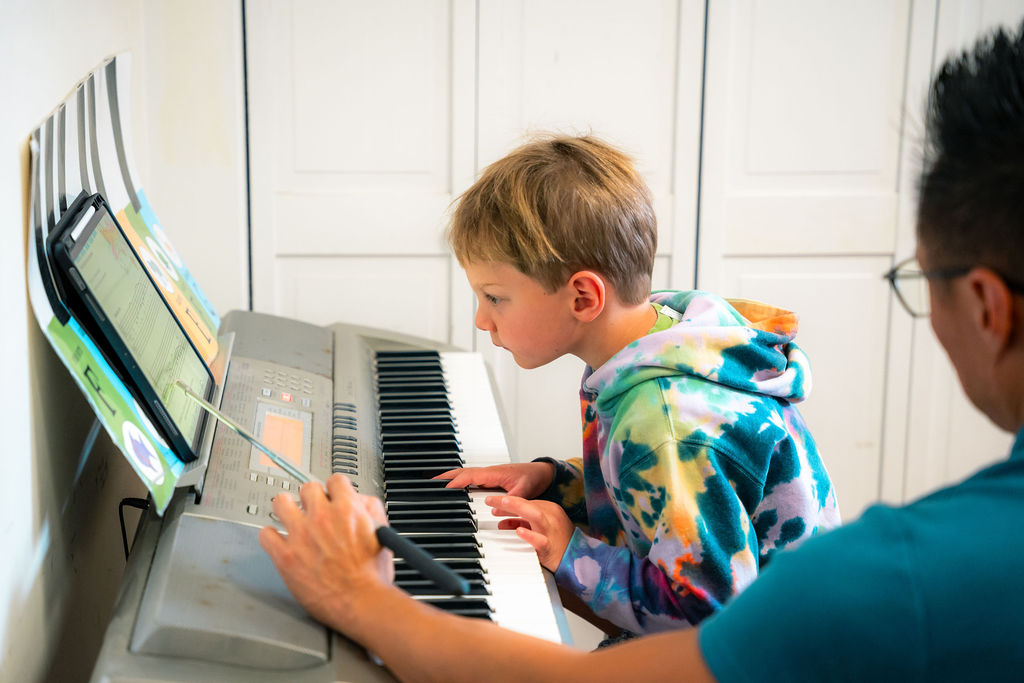
Our daily music program begins in infancy with songs, movement, and opportunities to explore rhythm and sound.
As children grow, they are introduced to more structured musical experiences, including small-group piano and violin lessons beginning around age three.
Music gives children opportunities to practice listening, coordination, concentration, and self-expression.
Outdoor learning is another important part of our approach.
Through gardening and nature exploration, children can observe changes in their environment, ask questions, develop patience, and learn about the world through direct experience.
These activities complement early literacy, mathematics, science, and social development.
We want children to develop the skills they'll need for kindergarten while also enjoying the childhood they're experiencing right now.
Childcare is a significant financial commitment for many Newton families.
When comparing programs, tuition is naturally an important consideration. But the monthly price doesn't always tell you everything about the experience.
Some centers charge separately for enrichment activities, supplies, or additional programming.
Others include these experiences within their tuition.
At Artisan, our tuition includes classroom materials and enrichment opportunities such as daily music programming and gardening, along with other applicable program benefits.
For families who value early music education, creative exploration, and a well-rounded curriculum, these experiences are worth considering when comparing schools.
It's also important to think about practical factors.
Does the school's schedule work for your family? Are full-time and part-time options available? What is included in the tuition? Are there additional fees?
We encourage families to ask these questions early so they can make informed decisions based on both their priorities and their budget.
The right childcare program should offer an experience that feels worthwhile for your family, not simply the longest list of amenities.
Every child is different.
Some children walk confidently into a new classroom and immediately begin exploring.
Others prefer to observe quietly before joining an activity.
Some need extra reassurance during transitions, while others become comfortable in a new environment relatively quickly.
None of these responses necessarily indicates whether a childcare center is a good fit.
What matters is how the adults respond.
Are teachers patient with children who need more time? Do they recognize different personalities and temperaments? Are children encouraged to participate without being pressured?
A supportive early learning environment makes room for children to develop at their own pace.
At Artisan, our philosophy is centered on recognizing the individuality of each child.
We believe that children should have opportunities to develop independence, build confidence, and discover their interests while knowing they have caring adults to turn to when they need support.
For some children, that might mean spending extra time with a teacher before joining a group activity.
For others, it might mean having the freedom to pursue a particular interest through art, music, or imaginative play.
There is no single definition of a successful day in early childhood.
Sometimes, success looks like a child proudly writing the first letter of their name.
Other times, it looks like making a new friend, trying an unfamiliar activity, or feeling brave enough to say goodbye at drop-off.
Those moments matter, too.
Online research can help you narrow down your options, but it can only tell you so much.
You can read about a school's curriculum, browse photos, compare tuition, and learn about its educational philosophy.
What you can't fully understand from a website is how the classroom feels when children and teachers are interacting.
That's why visiting a childcare center is such an important part of the decision-making process.
During a tour, take your time.
Observe the classrooms. Ask questions. Meet the educators. Learn about the daily routines and how the program approaches the things that matter most to your family.
You should leave feeling better informed about both the strengths of the program and whether it aligns with your child's needs.
And remember, choosing childcare isn't about finding a school that looks perfect on paper.
It's about finding a place where your child can develop meaningful relationships, explore their interests, and receive the care and attention they need during these important early years.
At Artisan, we know choosing childcare is a big decision, and we want families to feel comfortable taking the time to make it.
Our Newton campus serves infants, toddlers, and preschoolers, offering a play-based curriculum that brings together early academics, daily music education, creative exploration, and outdoor learning.
But we'd much rather show you what that looks like than simply tell you about it.
We invite you to visit our Newton campus, meet our teachers, explore the classrooms, and ask us anything you'd like to know about our programs.
Whether you're beginning your childcare search or narrowing down your options, we'd love to learn more about your child and what you're looking for.
Schedule a personal tour of Artisan Childcare Center in Newton, MA, and see whether our community feels like the right fit for your family.